


 PLATFORM UPDATE:


Cost-effective chloramphenicol residue monitoring in food-producing animal samples: a hybrid QuEChERS–MIP extraction method coupled with chrome azurol S spectrophotometry
 *a
Aktham N.
Jasim
c
and
*a
Aktham N.
Jasim
c
and
Abstract
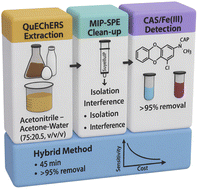
Effective monitoring of chloramphenicol (CAP), a banned antibiotic in food-producing animals due to serious human health risks, demands highly sensitive and cost-efficient analytical methods suitable for complex matrices. This study presents a novel hybrid approach integrating modified QuEChERS extraction, molecularly imprinted polymer solid-phase extraction (MIP-SPE) clean-up, and derivatization-free chrome azurol S (CAS)/Fe(III) spectrophotometric detection for CAP quantification in beef, milk, and eggs. Key innovations include (1) optimization of QuEChERS using a ternary solvent system (acetonitrile : acetone : water, 75 : 20 : 5, v/v/v), significantly enhancing CAP solubility (15.8 mg mL−1) and recovery (94 ± 3%) while suppressing matrix effects (9%); (2) implementation of SupelMIP®SEP cartridges for highly selective CAP isolation, eliminating >90% of interferents with minimal cross-reactivity (e.g., thiamphenicol: 2.1%); and (3) exploitation of a pH-dependent (5.0–5.5) coordination reaction between CAP's hydroxyl groups and the Fe(III)–CAS complex, inducing a distinct bathochromic shift (480 nm → 545 nm) for specific quantification. Rigorously validated per ICH guidelines, the method demonstrates exceptional performance: high sensitivity (LOD: 0.1 µg kg−1; LOQ: 0.3–0.4 µg kg−1, meeting the stringent EU MRL of 0.3 µg kg−1), excellent accuracy (recoveries: 85.2–103.6%; RSD ≤ 7.8%, n = 6), and superior specificity (negligible interference from endogenous components and structural analogs, <5% signal deviation). This rapid 45-minute workflow achieves HPLC-MS/MS-level sensitivity at minimal cost ($0.50–$1.00 per sample) using standard UV-Vis instrumentation. It outperforms immunoassays by reducing cross-reactivity and conventional colorimetry by eliminating derivatization, offering a robust, field-deployable solution for reliable CAP screening and quantification in resource-limited settings.
- This article is part of the themed collection: Analytical Methods HOT Articles 2025
 Please wait while we load your content...


