


 PLATFORM UPDATE:


Analytical applications of gas-phase ion chemistry enabled by mass spectrometry

Abstract
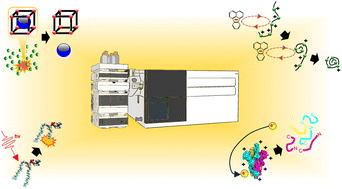
Analytical mass spectrometry (MS) has been employed to study a wide variety of analytes, including metabolites, lipids, pharmaceutical compounds, pesticides, petroleum, peptides, proteins, protein complexes, nucleic acids, and glycans. The field of gas-phase ion chemistry in mass spectrometry studies the impacts of the chemical behaviors and properties of ions produced from these samples, along with instrumental and methodological parameters of the MS experiment, in determining the appearance of the resulting mass spectra. This subfield includes the dynamic interactions of the ions with neutral molecules, electrons, photons, and other ions. These interactions are particularly useful in tandem mass spectrometry (MS/MS or MSn) experiments, which provide high specificity and enable analyte structural characterization by fragmenting a compound of interest and then analyzing the product ions. These bimolecular interactions can also result in non-dissociative processes, leading to ion transformation, charge alteration, or the formation of ion/molecule and ion/ion complexes. Such reactions offer valuable insights into chemical behavior across various reaction environments by simulating those conditions within the mass spectrometer. This information can then be used to make novel inferences about the sample and promises to inform MS studies in areas such as metabolomics, lipidomics, drug pharmacology, exposomics, proteomics, glycomics, genomics, and environmental, supramolecular, and interstellar chemistry. In this review, we highlight novel applications of tandem mass spectrometry that have been published in the past ten years, focusing on reactions that take place in the gas phase in a reduced-pressure environment (i.e., ion/neutral atom/molecule, ion/electron, ion/photon, and ion/ion reactions), largely after the ionization step.
- This article is part of the themed collections: Analytical Methods Review Articles 2026 and Analytical Methods HOT Articles 2026
 Please wait while we load your content...


