


 PLATFORM UPDATE:


Methylation-enhanced fluorescent dyes for highly sensitive detection of hypochlorous acid and biological imaging

Abstract
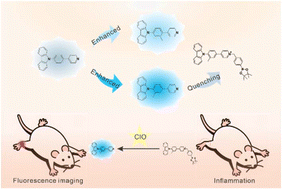
Regulating the photoluminescence of fluorescent dyes via steric hindrance engineering is a promising strategy for advancing fluorescence imaging technology. In this work, we introduce a methylation-induced steric hindrance approach to significantly amplify the fluorescence intensity. Two novel methylated fluorescent dyes were rationally designed and synthesized by site-specific introduction of methyl groups onto the carbazole framework. Theoretical calculations revealed that the fluorescence enhancement mechanism originated from the reduced Huang–Rhys factors and the suppressed low-frequency vibrational reorganization energy in the excited state. As a proof-of-concept application, an optimized fluorescent probe for hypochlorous acid (HClO) detection was constructed based on this methylation strategy, exhibiting excellent tissue permeability, biocompatibility, and high selectivity toward HClO. This enabled successful in vivo imaging of hypochlorous acid. This study not only elucidates the molecular mechanism underlying steric-hindrance-mediated fluorescence enhancement, but also provides a theoretical basis and practical design guideline for the development of high-performance fluorescent probes for chemical sensing and biological imaging.
 Please wait while we load your content...


