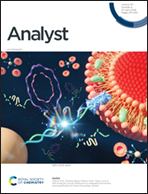
DNA nanotechnology for nucleic acid analysis: Detection of RNA and dsDNA amplicon using multifunctional DNAzyme nanomachine (DNM)

Abstract

DNA has long been recognized as a promising material for biotechnological applications. Here, we demonstrate how DNA nanotechnology can enhance the sensing of practically important forms of nucleic acid analytes, including folded singlestranded RNA (ssRNA) and double-stranded DNA (dsDNA) amplicons. We designed and optimized a multifunctional DNAbased sensor incorporating the catalytic DNAzyme 10-23, named here DNAzyme-based molecular machine (DNM), and compared its performance with that of the classical binary 10-23 DNAzyme (BiDz) probe in detecting ssDNA, ssRNA, and dsDNA targets. The newly developed sensor exhibited up to 100 and 20-fold lower limits of detection (LOD) for ssDNA and ssRNA, respectively. Unlike traditional BiDz, DNM was capable of detecting as little as 1 µL of dsDNA amplicon (2 nM) within a 30 min assay, achieving excellent target specificity. We suggested an explanation of the nucleic acid complexes' behaviour with the respect to Gibbs energy.2

Supplementary files

Article information

Article type
Paper
Submitted
10 Mar 2026
Accepted
13 Apr 2026
First published
14 Apr 2026
This article is Open Access
Creative Commons BY-NC license

Analyst, 2026, Accepted Manuscript

DNA nanotechnology for nucleic acid analysis: Detection of RNA and dsDNA amplicon using multifunctional DNAzyme nanomachine (DNM)

M. Ateiah, S. S. Zablotskaya, M. S. Rubel and D. M. Kolpashchikov, Analyst, 2026, Accepted Manuscript , DOI: 10.1039/D6AN00265J

This article is licensed under a Creative Commons Attribution-NonCommercial 3.0 Unported Licence. You can use material from this article in other publications, without requesting further permission from the RSC, provided that the correct acknowledgement is given and it is not used for commercial purposes.

To request permission to reproduce material from this article in a commercial publication, please go to the Copyright Clearance Center request page.

If you are an author contributing to an RSC publication, you do not need to request permission provided correct acknowledgement is given.

If you are the author of this article, you do not need to request permission to reproduce figures and diagrams provided correct acknowledgement is given. If you want to reproduce the whole article in a third-party commercial publication (excluding your thesis/dissertation for which permission is not required) please go to the Copyright Clearance Center request page.

Read more about how to correctly acknowledge RSC content.

Social activity

Spotlight

Advertisements