


 PLATFORM UPDATE:


Metal–organic framework-based molecularly imprinted polymers for the dispersive solid-phase extraction of fluoroquinolones in coastal zone water and biological samples
 a
and
Jinhua
Li
*ab
a
and
Jinhua
Li
*ab
Abstract
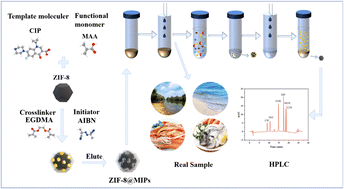
The coastal zone is a critical interface between terrestrial and marine systems, providing ecosystem services and economic value while serving as a major sink for land-derived contaminants. The identification and quantification of new pollutants (NPs), particularly antibiotics, even as trace residues, in coastal environments are necessary owing to their potential ecological and human-health risks. Given the complex, high-salinity matrices of samples from coastal zones and their low analyte concentrations, efficient sample pretreatments for cleanup and enrichment are required. Metal–organic framework-based molecularly imprinted polymers (MOF-MIPs), integrating the high porosity and surface area of MOFs with the molecular recognition ability of MIPs, have become promising sorbents for solid-phase extraction (SPE). Herein, a core–shell ZIF-8@MIP composite was facilely synthesized via surface imprinting and one-pot precipitation polymerization using ciprofloxacin (CIP) as the template and the ZIF-8 MOF as the core. The morphology, structure and composition of the composite were well characterized, and the adsorption equilibrium could be reached within 30 min, with a high maximum adsorption capacity of 151.96 mg g−1. Then, the ZIF-8@MIPs-based dispersive SPE (DSPE) coupled with HPLC–UV was developed for the simultaneous enrichment and determination of six fluoroquinolone antibiotics (FQs) in coastal zone water and biological samples. Under optimized conditions, low limits of detection of 0.060–1.440 μg L−1 and limits of quantification of 0.201–4.799 μg L−1 were achieved. Spiked recoveries in beach seawater, aquaculture wastewater, river water, and biological samples (pomfret and prawn) ranged from 92.6% to 118.9%, with relative standard deviations (RSDs) within 0.2%–6.1%. The present DSPE–HPLC study offers a simple and alternative method for NP analysis in coastal samples and could enrich the research scope of MOF-MIP-based sample pretreatment.
- This article is part of the themed collection: Analyst HOT Articles 2026
 Please wait while we load your content...


