


 PLATFORM UPDATE:


Lanthanide complex-based dual-modal probes for background-free time-gated luminescence and 19F magnetic resonance detection of hypochlorous acid in acute kidney injury
 b
and
Bo
Song
*a
b
and
Bo
Song
*a
Abstract
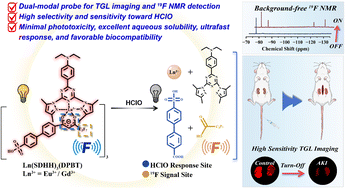
Acute kidney injury (AKI) is a life-threatening clinical syndrome often triggered by drug-induced nephrotoxicity, yet its early diagnosis remains challenging due to the lack of sensitive and specific biomarkers. Hypochlorous acid (HClO), a highly reactive oxygen species, plays a pivotal role in the oxidative damage that drives AKI progression. To achieve precise in situ monitoring of this pathological event, we designed and synthesized a water-soluble lanthanide complex probe, Ln(SDHH)3(DPBT) (Ln3+ = Eu3+, Gd3+), as a dual-modal sensing platform for intrinsically background-free detection of HClO via time-gated luminescence (TGL) and 19F magnetic resonance (MR) sensing. By integrating a sulfonate-functionalized β-diketonate ligand (SDHH) to enhance aqueous solubility and biocompatibility, together with an extended π-conjugated antenna (DPBT) to enable visible-light excitation, this probe overcomes the limitations of traditional lanthanide complex-based probes. Upon exposure to HClO, selective oxidative cleavage of the SDHH ligand induces rapid quenching of Eu3+ luminescence and simultaneously restores the 19F NMR signal by eliminating the Gd3+-mediated paramagnetic relaxation enhancement (PRE) effect. The probe exhibits an ultrafast response (<7 s), high selectivity and sensitivity (LOD = 87 nM for TGL detection), and exceptional biocompatibility. Leveraging these advantages, Eu(SDHH)3(DPBT) successfully enabled high-contrast visualization of endogenous HClO fluctuations in cisplatin-stimulated renal cells and in an AKI mouse model. Collectively, this dual-modal platform provides a robust tool for real-time in situ visualization of HClO, facilitating mechanistic investigations and early diagnosis of oxidative stress–related organ injury.
- This article is part of the themed collection: Analyst HOT Articles 2026
 Please wait while we load your content...


