


 PLATFORM UPDATE:


In situ growth of Pd nanoparticles on wood for highly sensitive hydrogen sensing

Abstract
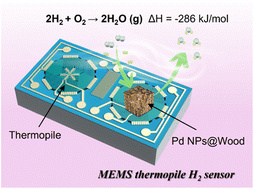
As a flammable and explosive clean energy source, the safe detection of H2 is of paramount importance. This study utilizes naturally occurring lignin in wood as a reducing agent to achieve the green and in situ growth of Pd nanoparticles (NPs). Subsequently, this material is integrated with a MEMS thermopile to fabricate a highly sensitive H2 sensor. This work systematically analyzes the influence of wood types on the in situ growth of Pd NPs and their H2 sensing performance. The experimental results indicate that Pd NPs loaded on Balsa wood exhibit superior sensing performance over those loaded on Mongolian pine and Spruce wood. At an optimal operating temperature of 200 °C, the sensitivity of the Balsa wood-based sensor to H2 is about 4 times and 4.5 times higher than those of the Mongolian pine-based and Spruce-based sensors, respectively, while its response time is 50% and 60% lower than those of Mongolian pine-based and Spruce-based sensors, respectively. Furthermore, the Balsa wood-based sensor demonstrates a low detection limit (<1 ppm), a wide linear detection range (1 ppm to 2%), and excellent selectivity. This is primarily attributed to two key structural and compositional characteristics of Balsa wood. First, Balsa wood possesses a unique porous fibrous network structure that provides rapid diffusion pathways for gas transport. Second, among the three types of wood, Balsa wood exhibits the highest lignin content and active chemical interface, which enables sufficient and uniform in situ reduction of Pd NPs. This study not only presents a novel synthesis strategy for sensing materials to develop high-performance H2 sensors but also offers a feasible pathway for the value-added application of biomass resources in the field of sensing.
 Please wait while we load your content...


