


 PLATFORM UPDATE:


Separating O-desmethylvenlafaxine and tramadol enantiomers using two-dimensional chiral LC × DMS mass spectrometry
 †a
Emir
Nazdrajić,
a
Diana M.
Cárdenas-Soracá,
b
Leslie M.
Bragg,
b
Mark R.
Servos
b
and
W. Scott
Hopkins
*ac
†a
Emir
Nazdrajić,
a
Diana M.
Cárdenas-Soracá,
b
Leslie M.
Bragg,
b
Mark R.
Servos
b
and
W. Scott
Hopkins
*ac
Abstract
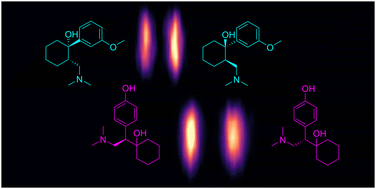
Tandem mass spectrometry relies on unique parent-to-product transitions for selective analysis. For sets of isomers or isobars that have identical behaviors in multiple separation dimensions (e.g., LC retention, m/z), quantitation is challenging owing to feature convolution. For example, recent environmental analysis of the enantiomers of O-desmethylvenlafaxine (ODV), an anti-depressant manufactured in a racemic mixture, identified tramadol (TRA, a racemic painkiller) as a co-eluting interference. Here, we demonstrate that differential ion mobility spectrometry (DMS) coupled with chiral LC-MS2 can be used to separate and quantify the enantiomers of ODV and TRA. This method was applied to six wastewater influent samples from an Ontario municipal wastewater plant, where the sum of the enantiomeric concentrations was statistically identical to the racemic concentrations observed on reverse-phase LC-MS2 (t-test, α = 0.05, p-value = 0.26 for ODV and p-value = 0.47 for TRA). We also identify low-intensity product ions specific to ODV that enable isolation and quantitation via chiral LC-MS2 alone, albeit at a relatively high limit of quantitation (LOQ) in comparison to the most intense MRM transition (m/z 264 → 58). Using our chiral (LC × DMS)-MS2 method, the instrumental LOQ of each enantiomer of TRA was determined to be 0.67 ng mL−1 and 5.0 ng mL−1 for the enantiomers of ODV.
 Please wait while we load your content...


