


 PLATFORM UPDATE:


A simple photothermal paper-based analytical device using silver nanomaterials for quantitative mercury ion monitoring in drinking water and Wolffia samples
 *abc
Wijitar
Dungchai
*b
*abc
Wijitar
Dungchai
*b
Abstract
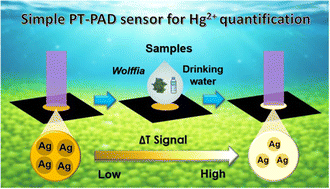
Herein, we present a sensitive and straightforward photothermal-based paper analytical device (PT-PAD) for quantifying mercury ions (Hg2+) in drinking water and Wolffia samples, facilitating rapid screening of the quality of aquatic plants in association with environmental water. The technique involves the etching reaction of silver nanoparticles (AgNPs) with Hg2+ on the paper substrate, which leads to a change in their photothermal conversion. The Hg2+ levels can be detected by monitoring the temperature change under irradiation with a 405 nm laser pointer. The sensor established a working linear range between 3.0 and 11.0 ppb with a detection limit (LOD) of 0.06 ppb. Furthermore, it offers remarkable precision with a maximum relative standard deviation (RSD) of 7.3%. Likewise, there were no significant interference effects from both anions and cations, indicating high selectivity for Hg2+ monitoring. The proposed method exhibits excellent accuracy and precision for detecting Hg2+ levels in drinking water and Wolffia samples, with a recovery range of 96.0–104.0% and the highest RSD of 4.4%. These results are compatible with those obtained by the inductively coupled plasma mass spectrometry (ICP-MS) method. Despite not using complex instruments, the assay shows a greater detection performance compared to most of the previous microfluidic paper-based analytical devices (µPADs). Overall, our developed PT-PAD sensor provides a promising approach for the sensitive detection of Hg2+ levels in both drinking water and Wolffia samples and could be extended to monitor other samples with outstanding detection capability. Moreover, the concept of etching-induced photothermal analysis can be applied to other analytes, making this highly sensitive method suitable for future sensing development.
 Please wait while we load your content...


