


 PLATFORM UPDATE:


Fluorescent aptasensor for enrofloxacin detection based on APE1-assisted amplification and CsPbBr3@MSN nanocomposites
 *a
and
Hong
Zhou
*a
*a
and
Hong
Zhou
*a
Abstract
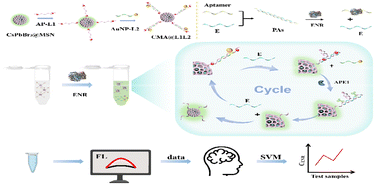
In this work, a fluorescent aptasensor was constructed for enrofloxacin (ENR) detection by combining the polyvalent aptamer (PA) structure, apurinic/apyrimidinic endonuclease 1 (APE1)-mediated signal amplification and mesoporous silica-encapsulated perovskite quantum dot (CsPbBr3@MSN) nanocomposites. With their multiple recognition sites, polyvalent aptamers bonded to ENR and released the trigger for the strand displacement reaction. Meanwhile, a highly sensitive FRET-based sensor was constructed using the CsPbBr3@MSN probe and gold nanoparticles (Au NPs). In the presence of the trigger and APE1, the fluorescence was recovered by separating the CsPbBr3@MSN probe and Au NPs via a cyclic strand displacement reaction. Coupled with the signal amplification strategy, this system achieved the linear detection of ENR in the range of 0.1 pg mL−1 to 50 ng mL−1 with a detection limit of 0.073 pg mL−1. This sensor offers a novel analytical strategy for detecting antibiotic residues and holds significant potential for applications in food safety monitoring and environmental analysis.
 Please wait while we load your content...


