


 PLATFORM UPDATE:


Heterojunction-engineered two-dimensional Ti3C2–CoFe2O4 nanozyme with oxidase-like activity for SERS detection of glutathione in human serum
 *a
and
*a
and
Abstract
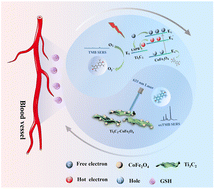
The inherently weak Raman signals from molecules with small scattering cross-sections pose a significant challenge for surface-enhanced Raman scattering (SERS), a technique that is further limited by its reliance on costly precious metal substrates and exogenous labeling strategies. To address these limitations, this study constructs a Ti3C2–CoFe2O4 heterostructure by anchoring oxidase (OXD)-like CoFe2O4 nanoparticles (NPs) on two-dimensional (2D) conductive Ti3C2 MXene nanosheets. The resulting interface forms a Mott–Schottky junction, which facilitates rapid charge transfer and synergistically enhances both catalytic and SERS performance. Structurally, the 2D Ti3C2 framework provides abundant anchoring sites for the uniform dispersion of CoFe2O4 NPs. This effectively prevents particle aggregation and maximizes the exposure of catalytic active sites, thereby enhancing both stability and catalytic activity. Additionally, the Ti3C2–CoFe2O4 heterojunction effectively suppresses the recombination of charge carriers and promotes the separation of photogenerated charges, generating abundant superoxide anion radicals that oxidize 3,3′,5,5′-tetramethylbenzidine (TMB) for catalytic signal amplification. Therefore, the ingenious combination of nanozymes and SERS technology enables the generation of SERS-active reporters via nanozyme-catalyzed reactions, thus avoiding the need for external labeling modifications. The strategy simultaneously enhances Raman signals through the synergistic effect of photoinduced charge transfer and localized surface plasmon resonance. This Ti3C2–CoFe2O4 heterojunction exhibits integrated OXD-like activity and SERS enhancement, enabling sensitive glutathione (GSH) detection in human serum samples. Through catalytic oxidation of TMB to oxidized TMB, a distinct Raman peak emerges at 1615 cm−1, with its intensity reduction quantitatively correlating with GSH concentration via competitive reactive oxygen species scavenging. Quantitative analysis demonstrates a linear response range of 0.50–200 μmol L−1 and a detection limit of 0.073 μmol L−1, with serum sample recoveries ranging from 94.7%–115%. This study provides a paradigm for designing non-precious metal nanozyme materials with integrated catalytic and SERS capabilities, demonstrating significant potential for practical applications in clinical diagnostics and biosensing.
- This article is part of the themed collection: Analyst HOT Articles 2026
 Please wait while we load your content...


