


 PLATFORM UPDATE:


Disentangling method-induced differences in metabolomics: single- versus dual-phase extraction
 *a
*a
Abstract
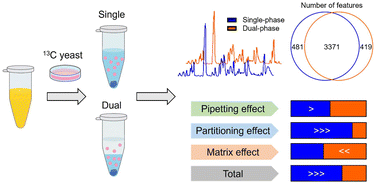
Efficient metabolite extraction is a key determinant of metabolome coverage and data quality in metabolomics. In this study, we systematically compare two widely used metabolite extraction strategies in untargeted metabolomics, including methanol-based single- and methyl tertiary-butyl ether (MTBE) based dual-phase solvent systems, and evaluate their performance across common urine and plasma, in liquid chromatography-mass spectrometry (LC-MS)-based metabolomics. Through a rational experimental design, we disentangled the multifactorial differences between single- and dual-phase extractions into three analytically distinct components: pipetting, partitioning, and matrix effects. We further employ a comprehensive panel of isotopically labelled internal metabolite standards derived from 13C-labeled yeast extract to quantitatively characterize extraction-induced metabolic changes. Our results indicate that pipetting-induced variability is minimal, as polar standards exhibit fold changes close to unity between single- and dual-phase extraction protocols. In contrast, partitioning effects are strongly governed by solvent composition and phase volume ratios. For example, in plasma dual-phase extraction, where aqueous and organic phases are approximately equal, partitioning losses are limited. However, in urine dual-phase extraction, a higher organic-to-aqueous volume ratio promotes substantial redistribution of nonpolar metabolites into the organic phase. In addition, matrix effects further contribute to selective differences between the two methods, with ion suppression observed for subsets of compounds within specific retention time regions. Ultimately, the observed net response of each metabolite reflects the combined influence of partitioning behavior and matrix effects. Collectively, these findings highlight the complex, multifactorial nature of extraction-driven differences in LC-MS-based metabolomics. The framework established here can be readily extended to future method development, enabling systematic and mechanistic evaluation of method-induced metabolic changes.
- This article is part of the themed collection: 150th Anniversary Collection: Metabolomics
 Please wait while we load your content...


