


MOF-metal nanohybrid-assisted charge transfer amplification for electrochemical biosensing of the MUC1 cancer biomarker

Abstract
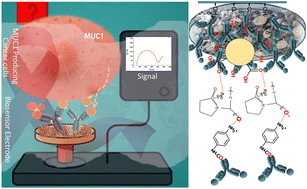
Cancer is a severe disease characterized by high mortality and complex pathophysiology; however, its early and accurate diagnosis remains inadequate. Conventional diagnostic approaches often fall short, particularly for dense tissues, and are frequently invasive, costly, and of limited availability. This reinforces the need for a compact, economical, and ultrasensitive assay that is operationally simple and interpretable. We present an efficient electrochemical detection platform for the cancer biomarker mucin 1 (MUC1). A fluorine-doped tin oxide (FTO) surface was modified with an iron-based metal–organic framework (FeMOF) intercalated with palladium nanorods (PdNR). FeMOF was prepared using Fe3+/Fe2+ precursors at a 1.2/1 mmol ratio and dual ligands, i.e. tetrahydroxy-1,4-benzoquinone and 2-aminobenzene-1,4-dicarboxylic acid. AntiMUC1 antibodies were immobilized on a modified electrode via p-phenylenediamine (PDA) (FTO/FeMOF@PdNR/PDA/antiMUC1Ab) and evaluated using electrochemical impedance spectroscopy (EIS) and voltammetry. The designed sensor demonstrated an excellent binding affinity for the MUC1 antigen. Among these techniques, the EIS method stands out for its technical performance, as evidenced by the high sensitivity (detection limit 0.074 fg mL−1), quantification limit 0.24 fg mL−1, and high analytical sensitivity (1.39 × 10³ Ω fg−1 mL−1 cm−2). The negligible cross-reactivity with interferent biomolecules, rapid response (10-minute equilibrium), regenerability up to 5 cycles, high reproducibility (RSD ∼1–3%), and long-term stability (up to 35 days) further validate the suitability of the proposed MUC1 immunosensor. This study presents an ultrasensitive biosensor that is compact, cost-effective, and easy for individuals at home to use after further development into a kit-based end product. Moreover, its excellent functionality for spiked serum samples shows promise for next-generation clinical diagnostics.
 Please wait while we load your content...


