


 PLATFORM UPDATE:


Negative selection assisted isolation of a highly selective DNA aptamer for the detection of 17α-ethinylestradiol
 *a
*a
Abstract
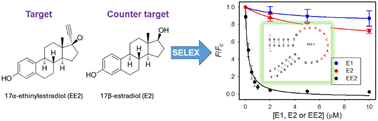
Estrogenic compounds, including both natural estrogens such as estrone (E1) and 17β-estradiol (E2) and synthetic 17α-ethinylestradiol (EE2), are widely recognized for their endocrine-disrupting effects in the environment. EE2 is a key ingredient in oral contraceptives, and it poses environmental challenges due to its resistance to biodegradation and bioaccumulation in aquatic systems. In this work, EE2 was used as a target to select DNA aptamers, and extensive negative selections were employed using E2 as a counter target to obtain highly selective aptamers. After 18 rounds of selections, two families of aptamers were obtained. Among them, a sequence named EE2-1 has a predicted secondary structure containing a highly conserved loop region connecting two duplex stems. EE2-1 has a Kd of 200 nM based on thioflavin T (ThT) fluorescence spectroscopy and 138 nM based on isothermal titration calorimetry. Using this ThT fluorescence assay, a limit of detection of 40 nM was determined, and its binding to E2 was much weaker. This aptamer provides a promising molecular recognition element for the development of biosensors and assays capable of detecting trace levels of EE2.
- This article is part of the themed collection: Analyst HOT Articles 2026
 Please wait while we load your content...


