


 PLATFORM UPDATE:


Proton transfer reagent cations for ion–ion charge state manipulation of high mass negatively-charged analytes in an electrodynamic ion trap
 †a
Boukar K. S.
Faye,
†a
Seth A.
Horn,
a
Alexander M.
Koers
a
and
Scott A.
McLuckey
*a
†a
Boukar K. S.
Faye,
†a
Seth A.
Horn,
a
Alexander M.
Koers
a
and
Scott A.
McLuckey
*a
Abstract
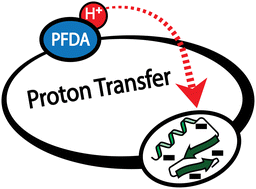
This work summarizes the criteria for a useful reagent for ion/ion proton transfer in an electrodynamic ion trap with specific emphasis on proton transfer to high mass multiply-charged analyte ions. A readily available and ionizable weak base of relatively high mass meets the criteria. The protonated form of an extensively fluorinated 10-carbon primary amine (1H,1H,2H,2H-perfluorodecylamine, PFDA) is demonstrated to serve as a useful reagent for proton transfer to negatively-charged proteins and oligonucleotides. The behavior of protonated PFDA is compared with that of protonated 1,8-bis(dimethylamino)naphthalene (proton sponge) with respect to the tendency for proton transfer versus attachment in ion/ion reactions with a common multiply-deprotonated protein and a common multiply-deprotonated oligonucleotide. Protonated PFDA showed a lesser tendency for ion attachment than the proton sponge in all cases. Both reagent cations showed a greater extent of attachment to the oligonucleotide anions. Mild collisional heating was shown to be able to extensively remove adducted PFDA from the oligonucleotide. The ability to generate low z and high m/z analyte product ions from highly charged precursor analyte ions using protonated PDFA is illustrated with anions derived from β-galactosidase, GroEL, and 30S E. coli ribosome particles.
- This article is part of the themed collection: Analyst HOT Articles 2026
 Please wait while we load your content...


