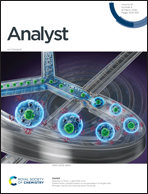
Selective electrochemical discrimination of 3′ isomiRs differing by two nucleotides

Abstract

MicroRNAs and isomiRs are promising biomarkers for the detection of diseases such as cancers, but distinguishing the highly similar microRNA sequences between these remains challenging. We report a five-strand four-way junction (5S-4WJ) electrochemical biosensor that combines universal reporter strands with target-specific probes for a modular, low-cost design. The system discriminates miR-146b from its isomiR (R + 2, +2 nt at 3′ end) by tuning the probe length, introducing mismatches, and controlling the hybridization kinetics. This strategy yields sevenfold higher sensitivity for R + 2 while maintaining specificity at 10–50 nM. Compared to existing electrochemical biosensors, which struggle to or do not test targets with extra nts at either 5′ or 3′, the 5S-4WJ sensor enables precise isomiR detection, advancing nucleic acid diagnostics.

Graphical abstract: Selective electrochemical discrimination of 3′ isomiRs differing by two nucleotides

Supplementary files

Article information

Article type
Paper
Submitted
07 Dec 2025
Accepted
25 Jan 2026
First published
26 Jan 2026
This article is Open Access
Creative Commons BY-NC license

Analyst, 2026, Advance Article

Selective electrochemical discrimination of 3′ isomiRs differing by two nucleotides

J. Ojeda, N. Bruno, K. Cover, W. C. Zhang and K. Chumbimuni-Torres, Analyst, 2026, Advance Article , DOI: 10.1039/D5AN01292A

This article is licensed under a Creative Commons Attribution-NonCommercial 3.0 Unported Licence. You can use material from this article in other publications, without requesting further permission from the RSC, provided that the correct acknowledgement is given and it is not used for commercial purposes.

To request permission to reproduce material from this article in a commercial publication, please go to the Copyright Clearance Center request page.

If you are an author contributing to an RSC publication, you do not need to request permission provided correct acknowledgement is given.

If you are the author of this article, you do not need to request permission to reproduce figures and diagrams provided correct acknowledgement is given. If you want to reproduce the whole article in a third-party commercial publication (excluding your thesis/dissertation for which permission is not required) please go to the Copyright Clearance Center request page.

Read more about how to correctly acknowledge RSC content.

Social activity

Spotlight

Advertisements