


 PLATFORM UPDATE:


A single fluorescent probe for simultaneous detection of Zn2+, Cd2+, and Pb2+ in industrial wastewater with application in bio-imaging and molecular logic gates

Abstract
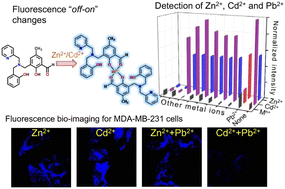
Detecting multiple metal ions, especially those from the same periodic group, is quite challenging with a single fluorophore-based sensing method because of their similar chemical properties. We introduce a unique fluorescent probe that can identify Zn2+, Cd2+, and Pb2+ simultaneously from their mixture, even in the presence of other metal ions, with the first two being in the same group of the periodic table. The design of the probe (L1) is based on the selective binding of Zn2+ or Cd2+, which triggers the fluorescence response of the phenolic aldehyde chromophore moiety, changing it from the off-mode to the on-mode due to its linkage with 2-(((pyridin-2-yl)methylamino)methyl)phenol, which restricts the photo-induced electron transfer (PET) process upon metal ion binding. Pb2+ acts as a unique metal ion, replacing Cd(II) but not Zn(II) from their respective complexes with L1. Using the preferential interaction of Pb2+ with the Cd(II)-complex, we were able to quantify not only Zn2+ and Cd2+, but also Pb2+ in their mixture with a detection limit below 0.01 μM. This can be achieved by formulating suitable analytical equations to determine the intensity value related to Cd(II)/L1 from the total intensity affected by all three metal ions, as well as the intensity reduction caused by Pb2+ for Cd(II)/L1. We measured Zn2+, Cd2+, and Pb2+ contents in nearby industrial wastewater. Fluorescence bio-imaging studies indicate that the probe is very effective in identifying elevated levels of Zn2+ and Cd2+ in cancer cells. Furthermore, we demonstrated that the reversible fluorescence responses of L1 in the presence of Zn2+, Cd2+, and Pb2+ are suitable for application in molecular logic gates.
 Please wait while we load your content...


