


 PLATFORM UPDATE:


Novel H2 colourimetric indicator for screening the activity of H2-generating bacteria and measuring their total viable count (TVC)

Abstract
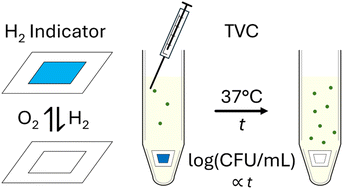
A novel colourimetric H2 indicator is described, comprising an intimate mixture of methylene blue, MB, and colloidal Pt particles, encapsulated in a polymer film and laminated between two thin sheets of low-density polyethylene. Upon exposure to H2, the blue coloured indicator turns colourless, as the MB is reduced to leuco methylene blue, but is restored to its original blue colour by air. The indicator is easy to make, stable, and reproducible, and is used to detect the presence of both gaseous and dissolved H2. The H2 indicator is used to screen for H2-generating bacteria, such as Escherichia coli, Klebsiella aerogenes, Enterobacter cloacae, and Clostridium bifermentans, under aerobic and anaerobic conditions. Here, the indicator is set in the bottom of a well plate containing the bacterium under test and its colour assessed by eye, or photographically. A value for the apparent absorbance, A′, of the indicator is obtained by digital colour analysis of its photograph and, for each bacterium, a series of reverse ‘S’ shaped A′ vs. incubation time, t, profiles are generated using different inoculated growth medium samples, covering a wide total viable count (TVC) range, typically, 101–108 CFU mL−1. Each profile has, at its half-way colour change point, an associated incubation time, t50, and, for all the H2 generating bacteria tested, the plot of log(TVC) vs. t50, is a straight line. This calibration graph is the basis of a new microrespirometry method, H2 μR-TVC, which compliments O2 μR-TVC. The potential applications of the H2 indicator are discussed briefly.
- This article is part of the themed collection: 150th Anniversary Collection: Sensors for Human and Planetary Health
 Please wait while we load your content...


