


A near-infrared benzothiazole-based fluorescent probe for selective detection of CORM-3 with a large Stokes shift in living cells
 *a
Jianmei
Zou
*a
*a
Jianmei
Zou
*a
Abstract
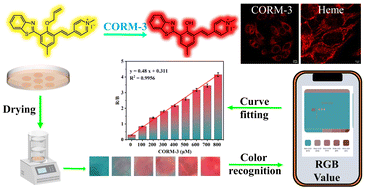
Carbon monoxide (CO) is a key signaling molecule in mammals, playing essential roles in cell protection and the maintenance of cellular homeostasis and exhibiting great therapeutic potential for various diseases. Moreover, dysregulation of endogenous CO metabolism has been closely linked to the development of multiple pathological conditions. Tricarbonyl chloride (glycine) ruthenium (CORM-3) can release low concentrations of CO within biological systems and demonstrates anti-inflammatory and cardioprotective properties. As a CO-releasing agent, CORM-3 offers significant potential for the treatment of various clinical conditions. Therefore, the development of effective analytical methods for detecting the CO-releasing agent CORM-3 is crucial for monitoring its levels and elucidating its specific biological mechanisms in vivo. Herein, we report a near-infrared fluorescent probe incorporating a benzothiazole fluorophore with an allyl ether moiety as the reactive site. The probe enables rapid and selective detection of CORM-3 by releasing the fluorophore. It exhibits excellent sensing performance, including fast response time, high selectivity and sensitivity, a large Stokes shift, and a turn-on fluorescence signal at 660 nm. Importantly, the probe effectively avoids issues related to heavy metal ion involvement and potential interference from nitroreductase, which are common limitations in existing methods. It has been successfully applied for visual detection of CORM-3 in living cells. Furthermore, the probe can be fabricated into test strips and, together with a smartphone-based RGB analysis application, allows for rapid and convenient on-site detection of CORM-3. These results demonstrate that the probe serves as a powerful tool for tracking CORM-3 in biological samples.
 Please wait while we load your content...


