


 PLATFORM UPDATE:


Visualization of heated latent fingerprints by synchrotron radiation soft X-ray photoemission electron microscopy
 *a
Masaki
Oura
a
and
*a
Masaki
Oura
a
and
Abstract
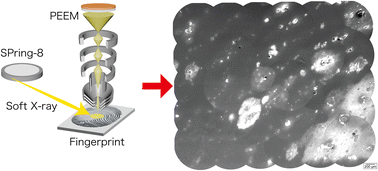
Fingerprint testing is routine for personal identification, but damaged prints, such as those exposed to heat in fire cases, are difficult to visualize. Currently, there is no method available to visualize severely heat-damaged fingerprints. We developed a visualization technique using synchrotron radiation (SR) soft-X-ray photoemission electron microscopy (PEEM). Fingerprints on silicon, stainless steel, aluminum, brass, and glass were heated at 400 °C for an hour and then examined. Ridge patterns could not be seen by optical microscopy, laser microscopy, or scanning electron microscopy, except on silicon. Even then, SR PEEM revealed ridge patterns by detecting sodium particles (∼1 μm) clustered into 10 μm spots. Multiple images were combined to successfully produce a clear 5 mm-wide ridge pattern. For the glass substrate, prior titanium vapor deposition prevented electric discharge, resulting in a clear ridge pattern observation by SR PEEM. Unlike conventional methods, SR soft-X-ray PEEM detects sodium sensitively and specifically, producing clear ridge patterns in heat-damaged fingerprints, which is promising for advanced criminal fingerprint testing.
 Please wait while we load your content...


