


 PLATFORM UPDATE:


Single-molecule nanopore profiling of protein domain fragment dynamics and aggregation

Abstract
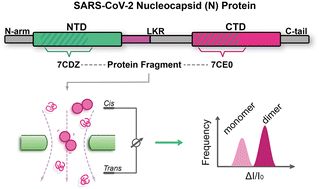
Protein fragmentation offers an effective approach for resolving localized conformational information and mapping discrete structural domains, yet current techniques may miss their dynamic behavior under changing external environments. Here, we harness nanopore sensing to interrogate 50-residue fragments from N-terminal (NTD) and C-terminal domains (CTD) of the SARS-CoV-2 nucleocapsid (N) protein under physiological conditions. We propose utilizing fractional current blockade (ΔI/I0) as a metric for the conformational spectrum, enabling us to probe the dynamics and aggregation behavior of protein fragments across various conditions. By systematically varying the voltage (70–300 mV) and employing complementary molecular dynamics simulations, we observe significant alterations in ΔI/I0 and translocation duration (τ), which indicate distinct domain-specific behaviors. Notably, the CTD fragment exhibits dimerization at lower voltages, followed by dissociation at elevated voltages, thus highlighting the capability of nanopore assays to resolve dynamic single-molecule transitions in real time. Additionally, we elucidate the electric field-dependent dimer dissociation behavior using size-variant nanopores and artificially modulate the environment of the CTD fragments to explore the factors affecting fragment dimerization. The full width at half maximum (FWHM) of the fitted conformational spectrum is employed to assess protein conformational flexibility and stability, influenced by voltage and ionic strength. Our findings not only reveal electric field-driven conformational plasticity of N-protein but also advance nanopore-based strategies for real-time protein domain analysis, informing antiviral therapeutic and diagnostic development.
- This article is part of the themed collection: Analyst HOT Articles 2026
 Please wait while we load your content...


