


 PLATFORM UPDATE:


Elucidating time-resolved intracellular metabolic dynamics via label-free Raman microspectroscopy and 2D correlation spectroscopy

Abstract
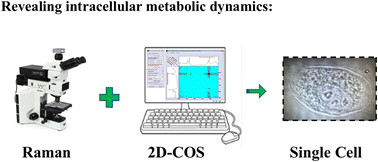
Understanding dynamic metabolic processes is central to elucidating cellular function and disease mechanisms. Glycolysis and glutaminolysis are particularly important, as they support bioenergetic and biosynthetic pathways, and their dysregulation is strongly linked to disorders. Raman spectroscopy provides a powerful, non-invasive approach for probing cellular dynamics, and recent advances in instrumentation and computational analysis have enhanced its sensitivity, enabling detection of subtle metabolic variations in complex environments. In this study, Raman spectroscopy combined with two-dimensional correlation spectroscopy (2D-COS) was applied to investigate metabolic responses of cells exposed either to glucose alone or glucose supplemented with glutamine, with emphasis on glutamine's effect on overall metabolic dynamics. Cells were starved for 2 h and then exposed to nutrients, after which they were fixed at 15 minute intervals for up to 2 h and spectroscopically monitored to evaluate the kinetic evolution of the metabolic response. To validate the approach, simulated datasets were initially used to model simplified metabolic pathway dynamics, which confirmed that 2D-COS could reliably track the kinetic evolution of simulated variables, even in the presence of high background interference. Analysis of cellular spectra revealed systematic temporal changes across biomolecular bands, suggesting partial synchronisation of metabolic responses, with oscillatory patterns observed under glucose-only conditions. In contrast, glucose–glutamine samples showed accelerated and amplified metabolic variability, with stronger correlations and additional variable bands, particularly linked to nucleic acid vibrations. Overall, these findings demonstrate the utility of Raman 2D-COS for resolving intracellular metabolic dynamics from complex datasets, offering new opportunities for advancing diagnostics and therapeutic interventions.
 Please wait while we load your content...


