


 PLATFORM UPDATE:


Tuning MIP-QCM selectivity for zinc ions via cross-linker/monomer ratio

Abstract
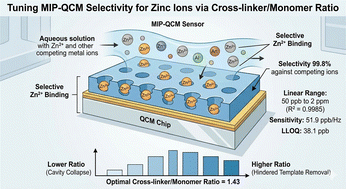
A highly selective and sensitive molecularly imprinted polymer (MIP) sensor on a quartz crystal microbalance (QCM) was developed for detecting zinc ions, Zn2+, in water. This work provides key insights into the critical role of the cross-linker/monomer ratio in optimizing MIP selectivity and sensitivity. Computational screening identified optimal functional monomers, leading to a stable MIP architecture with high Zn2+ binding affinity. The optimized MIP-QCM sensor exhibited remarkable performance: an exceptional selectivity of 99.8% against competing metal ions, a linear range from 50 ppb to 2 ppm (R2 = 0.9985) and a sensitivity of 51.9 ppb Hz−1. The lower limit of quantification (LLOQ) was 38.1 ppb, meeting regulatory thresholds. A cross-linker/monomer ratio of 1.43 was found to be optimal, as lower ratios caused cavity collapse and higher ratios hindered template removal. Compared to conventional methods, this MIP-QCM sensor is low-cost, rapid, and user-friendly, showing significant potential for commercialization.
 Please wait while we load your content...


