


 PLATFORM UPDATE:


Synchronous dual-mode sensing platform based on 1D chiral ionic COF for epoxiconazole detection
 *a
and
*a
and
Abstract
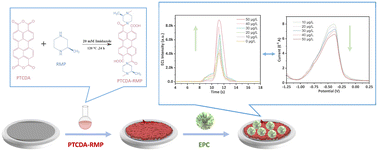
Pesticide misuse leads to environmental contamination and food safety risks. Herein, we report a dual-mode sensor based on a 1D ionic covalent organic framework (COF) for simultaneous electrochemiluminescence (ECL) and differential pulse voltammetry (DPV) detection. The COF ((R)-PTCDA-RMP) was synthesized through polycondensation of π-conjugated 3,4,9,10-perylenetetracarboxylic dianhydride (PTCDA) and chiral (R)-(−)-2-methylpiperazine (RMP) building blocks. This innovative platform utilizes pulsed voltage to generate synchronized ECL and DPV signals, achieving excellent linear responses to epoxiconazole (EPC) concentrations with detection limits (LODs) of 0.189 μg L−1 (ECL) and 5.15 μg L−1 (DPV). The sensor demonstrated high accuracy and satisfactory recoveries (95.3–103.8%) in orange fruit samples. This work establishes a robust method for rapid surveillance of pesticide residues in foodstuffs and environmental applications.
 Please wait while we load your content...


