


 PLATFORM UPDATE:


AQbD-driven UHPLC method for simultaneous quantification of budesonide, glycopyrronium bromide, and salbutamol sulphate: a unified approach for inhalation product and bioanalytical applications

Abstract
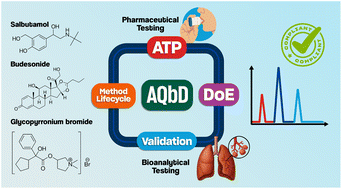
Inhalation therapies often combine budesonide, glycopyrronium bromide, and salbutamol sulphate, necessitating analytical methods capable of their simultaneous quantification. Conventional UHPLC methods typically address these active pharmaceutical ingredients (APIs) individually, leading to inefficiencies in development, validation, and regulatory alignment. Analytical Quality by Design (AQbD) has transformed pharmaceutical analytical method development through systematic risk assessment and structured optimization, but its application in the bioanalytical domain remains limited. The challenge addressed in this study is the creation of a single robust UHPLC method that meets both pharmaceutical and bioanalytical requirements within regulatory frameworks. A unified UHPLC method was developed using AQbD principles, employing Design of Experiments to identify and optimize critical method parameters. The optimized method achieved baseline separation of all three APIs on a YMC UltraHT Hydrosphere C18 (2.1 × 100 mm; 2.0 μm) column under gradient elution with methanol and 0.1% formic acid in 10 mM ammonium formate. Robustness was established through a defined Method Operable Design Region. The method was first validated under ICH Q2 (R2) for pharmaceutical applications, confirming accuracy, precision, and sensitivity. Subsequently, it was extended to the bioanalytical domain and validated under ICH M10 guidelines in simulated lung fluid, demonstrating reproducibility in complex matrices. This dual validation highlights the method's versatility and regulatory robustness, underscoring AQbD's ability to unify pharmaceutical and bioanalytical method development into a single lifecycle appropriate platform. This study demonstrates the first AQbD-driven UHPLC method validated under both ICH Q2 (R2) and ICH M10, bridging pharmaceutical and bioanalytical applications. Extending AQbD principles into bioanalysis provides a regulatory-relevant framework that enhances robustness, lifecycle flexibility, and compliance. The work establishes a unified strategy for inhalation therapies and beyond, supporting broader adoption of science- and risk-based analytical development.
 Please wait while we load your content...


