


 PLATFORM UPDATE:


Third-generation nanopore sequencing: advancing real-time pathogen detection and antimicrobial resistance surveillance in food safety applications

Abstract
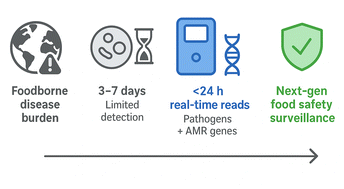
Foodborne diseases impact 600 million people annually, causing 420 000 deaths and over $110 billion in economic losses. Conventional pathogen detection methods take 3–7 days and lack sensitivity for low-abundance pathogens and antimicrobial resistance (AMR) genes. This review evaluates nanopore sequencing's potential in food microbiology, analyzing real-time pathogen detection, AMR surveillance, and performance versus traditional methods. A systematic review of 80 studies (2015–2025) revealed nanopore sequencing reduces detection time to <24 hours with 95–98% species identification accuracy and >90% AMR gene sensitivity, at $50–200 per sample versus $300–800 for traditional whole-genome sequencing. It enables multiplex pathogen detection, viable but non-culturable organism identification, and real-time AMR profiling. However, challenges include error rates of 8–15% in homopolymeric regions and the need for bioinformatics expertise. Addressing challenges, including error rates of 8–15% in homopolymeric regions and the need for bioinformatics expertise, requires strategic mitigation approaches. Despite limitations, advances in base-calling and workflows make nanopore sequencing a transformative tool for next-generation food safety surveillance.
- This article is part of the themed collections: Analyst Review Articles 2026 and Analyst HOT Articles 2026
 Please wait while we load your content...


