


 PLATFORM UPDATE:


Deterministic droplet-based co-encapsulation of single cells through inertial and hydrodynamic focusing

Abstract
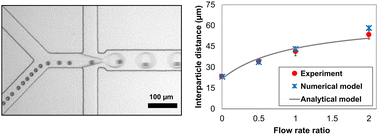
Microfluidic techniques for high-throughput encapsulation are powerful tools in single-cell analytics and cytokine profiling. Inertial focusing microfluidics is widely used to align particles in uniform sequences, enhancing encapsulation efficiency. However, on-chip sample dilution strategies to further optimize efficiency remain largely unexplored in deterministic encapsulation approaches, both experimentally and through theoretical modeling. Here, we present a high-yield microparticle encapsulation method that combines inertial and hydrodynamic focusing to enable precise tuning of microparticle spacing and modulation of capture efficiency, thereby offering enhanced operational flexibility for controlled particle encapsulation. We first investigate the microparticle self-ordering behavior within the spiral loop and characterize both flow dynamics and droplet formation regimes. By varying the sheath-to-sample flow rate ratio from 0 to 2, we observe that higher ratios increase the interparticle spacing and shift particles closer to the channel wall. These trends align with both analytical modeling and 3D numerical simulations. Notably, at higher sheath flow ratios (e.g., 1 and 2), single-particle encapsulation exceeds 76%, significantly surpassing Poisson distribution predictions. Moreover, single-cell capture efficiency exceeds 60% under these conditions. In co-encapsulation experiments, we achieved a one-cell-multiple-beads co-encapsulation efficiency near 40%, marking a significant improvement over the Poisson limit. For single-cell applications, we performed co-encapsulation of THP-1 monocytes and streptavidin-coated magnetic beads for TNF-α cytokine detection following lipopolysaccharide stimulation. Cytokine secretion was successfully detected at the single-cell level in both aqueous droplets and alginate hydrogels. We anticipate that this method will offer a promising platform for probing cell–cell interactions and immune responses at single-cell resolution.
 Please wait while we load your content...


