


Liquid–liquid phase separation-assisted Raman microscopy for sensitive and label-free analysis of enzymatic reactions and protein–small molecule interactions

Abstract
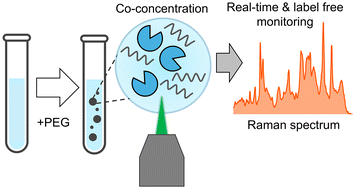
Raman spectroscopy enables label-free and non-destructive structural analysis of biomolecules; however, its application is limited by the inherently weak Raman signals, which necessitate high concentrations of biomolecules for detection. In our previous study, we developed a liquid–liquid phase separation (LLPS)-assisted Raman method, in which biomacromolecules are concentrated into PEG-induced droplets, enabling the acquisition of high signal-to-noise (S/N) Raman spectra from dilute solutions with small volumes, such as 30 μM and 50 μL. We demonstrate here its broad analytical utility for several applications, including real-time monitoring of catalytic reactions such as RNA degradation and quantitative detection of protein-small molecule interactions exemplified by the avidin–biotin system. Furthermore, small molecules such as amino acids, monosaccharides and supersulfides were successfully concentrated, allowing their Raman spectra to be obtained with markedly improved S/N ratios. This technique thus provides a simple, highly sensitive and versatile analytical platform for Raman-based biochemical studies, with wide potential applications in analyzing biomolecular structures and intermolecular interactions, as well as diagnostics.
 Please wait while we load your content...


