


 PLATFORM UPDATE:


Advanced multimodal imaging: FLIM, PLIM, and FluoRaman enabled by novel diarylacetylene probes
 *abc
Alexandra E.
Bailie,
e
Helen H.
Fielding,
a
Natalie A.
Belsey,
d
Michael
Shaw,
df
David R.
Chisholm
*c
*abc
Alexandra E.
Bailie,
e
Helen H.
Fielding,
a
Natalie A.
Belsey,
d
Michael
Shaw,
df
David R.
Chisholm
*c
Abstract
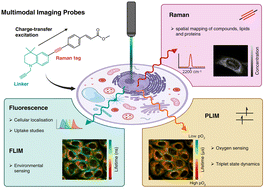
In drug design, understanding the subcellular localisation and physicochemical behaviour of candidate molecules is essential for optimising their efficacy and elucidating their mechanisms of action. Imaging probes are routinely employed for this purpose, though most studies rely on a single imaging modality. By integrating multiple imaging techniques into a multimodal system, a more comprehensive understanding of localisation, microenvironment, and physicochemical interactions can be achieved. Yet, there remains a scarcity of specialised imaging probes with well-defined photophysical profiles, especially those that combine luminescence with a Raman-active tag in the cell-silent region, where signal clarity is maximised. Such probes could function independently or be conjugated to drugs or targeting moieties as dual-mode imaging tags. In this study, we showcase the application of a suite of advanced imaging modalities: fluorescence microscopy (CLSM); Fluorescence Lifetime Imaging Microscopy (FLIM); Phosphorescence Lifetime Imaging Microscopy (PLIM); and simultaneous fluorescence and Raman spectroscopy (FluoRaman). The modalities were exemplified by a series of novel, highly solvatochromic diarylacetylene-based photosensitisers that feature alkyne Raman tags and exhibit diverse subcellular localisation.
 Please wait while we load your content...


