


 PLATFORM UPDATE:


From design to application: developments and challenges of nanomaterial-based optical biosensors for Salmonella detection

Abstract
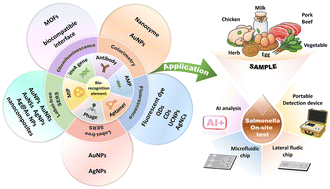
Salmonella is a widely distributed foodborne pathogen that poses a serious threat to public health. Traditional detection methods suffer from limitations such as being time-consuming, complex, and reliant on expensive equipment, making them unsuitable for rapid and on-site detection. In recent years, nanomaterial-based optical biosensors have emerged as a research hotspot in Salmonella detection due to their high sensitivity, strong specificity, fast response, and portability. These sensors offer new technological approaches for real-time monitoring and early warning of pathogens. This paper reviews the research progress of nanomaterial-based optical biosensors for Salmonella detection over the past five years, systematically summarizing the design principles, performance characteristics, and applications of different biorecognition elements and optical signal components in Salmonella detection. It also highlights the selection and integrated design strategies of combining different biorecognition elements with optical signal components to improve detection sensitivity, shorten detection time, and enhance specificity, providing a theoretical reference for researchers in this field. Finally, the paper analyzes the strengths and weaknesses of current technologies and discusses future development directions of nanomaterial-based optical biosensors for Salmonella detection, aiming to advance the technology and provide more efficient and reliable solutions for public health security.
- This article is part of the themed collection: Analyst Review Articles 2026
 Please wait while we load your content...


