


 PLATFORM UPDATE:


Advances and innovations in machine learning-based spectral detection methods for trace organic pollutants

Abstract
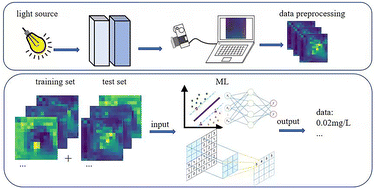
The rapid and sensitive detection of trace organic pollutants in water is crucial for ensuring environmental safety. Traditional detection methods struggle to meet the demands of large-scale, real-time, and on-site detection. This paper reviews recent advances in the application of machine learning (ML) in spectral detection methods for trace organic pollutants. It introduces techniques such as data augmentation, intelligent feature extraction, and model construction, as well as their application in different spectral techniques, for example, generative adversarial networks (GANs) for data augmentation, convolutional neural networks (CNNs) for feature extraction, and random forests (RF) for classification and identification. It focuses on exploring the combination of different spectral techniques and ML methods, such as the antibiotic database established by combining surface-enhanced Raman spectroscopy (SERS) and CNNs, and the classification of microplastics using infrared spectroscopy combined with RF. Through these combinations, ML enhances the sensitivity, selectivity, and robustness of detection. Furthermore, it provides an in-depth analysis of model interpretability methods and cross-laboratory validation frameworks, emphasizing the importance of building standardized detection processes and evaluation systems. Looking ahead, research in this field will focus on more efficient ML algorithms, deep integration of hardware and algorithms, and the expansion of application scenarios, to build an AI-driven autonomous decision-making system for pollutant detection and treatment.
- This article is part of the themed collection: Analyst Review Articles 2026
 Please wait while we load your content...


