


 PLATFORM UPDATE:


Surface charge engineering enhances symmetry and reliability of nanopores formed via dielectric breakdown
 *a
*a
Abstract
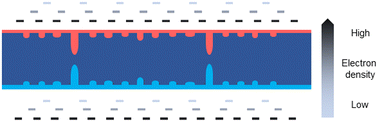
Achieving high geometric symmetry in solid-state nanopores is crucial for consistent signal response and molecular recognition. However, dielectric breakdown-based nanopore fabrication often yields asymmetric pore structures, particularly in thin membranes where local electric field fluctuations are pronounced. In this work, we systematically investigate the influence of membrane thickness and surface charge modification on nanopore symmetry. By introducing silane-based functional groups with distinct charge characteristics, we demonstrate that positively charged surfaces significantly reduce asymmetry. Phase-resolved analysis of the breakdown current–voltage curves reveals that positive surface charge minimizes voltage fluctuations throughout the breakdown process, as quantified by the relative standard deviation. Breakdown voltage is also increased, indicating enhanced dielectric robustness. All-atom molecular dynamics simulations show that positive modification promotes electron and ion accumulation near the membrane interface, stabilizing the local electric field and guiding more deterministic breakdown paths. These findings offer mechanistic insights and practical strategies to enhance the precision, reproducibility, and controllability of nanopore fabrication, paving the way for improved nanopore-based sensing applications.
 Please wait while we load your content...


