Issue 8, 2025

In situ confinement of ultrahigh-density Co2P nanoparticles within biomass-derived carbon nanosheet frameworks as efficient cocatalysts for solar H2 production

Abstract

In this work, an efficient and cost-effective H2 evolution cocatalyst (Co2P/CPE) is developed by in situ confinement of ultrahigh-density Co2P nanoparticles within a carbonized Pleurotus eryngii (CPE) matrix. Benefiting from the ultrathin carbon nanosheet architectures and exposure of ultradense Co2P nanoparticles (NPs), Co2P/CPE exhibits superior cocatalytic performance for the photocatalytic H2 evolution reaction (HER) in an Erythrosin B-triethanolamine (ErB-TEOA) system under visible light (λ ≥ 420 nm), achieving an exceptionally high H2 evolution rate of 449 μmol h−1 with an apparent quantum efficiency (AQE) of 8.7% at 500 nm. Remarkably, the excellent structural integrity ensures outstanding stability during consecutive HER cycles over 36 h. Furthermore, Co2P/CPE demonstrates excellent versatility as an active and durable cocatalyst to significantly enhance the photocatalytic HER activity of CdS NPs under visible light (λ ≥ 420 nm). This work establishes a paradigm for designing cost-effective and efficient HER cocatalysts through synergistic integration of biomass-derived carbon architectures with precisely engineered active sites.
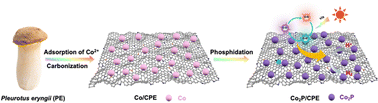
Graphical abstract: In situ confinement of ultrahigh-density Co2P nanoparticles within biomass-derived carbon nanosheet frameworks as efficient cocatalysts for solar H2 production

Supplementary files

Article information

Article type
Communication
Submitted
23 Apr 2025
Accepted
12 Jun 2025
First published
13 Jun 2025
This article is Open Access
Creative Commons BY-NC license

Energy Adv., 2025,4, 1006-1012

In situ confinement of ultrahigh-density Co2P nanoparticles within biomass-derived carbon nanosheet frameworks as efficient cocatalysts for solar H2 production

F. Wang, J. Wang, J. Zhang, Y. Li, Z. Zhang and S. Min, Energy Adv., 2025, 4, 1006 DOI: 10.1039/D5YA00112A

This article is licensed under a Creative Commons Attribution-NonCommercial 3.0 Unported Licence. You can use material from this article in other publications, without requesting further permission from the RSC, provided that the correct acknowledgement is given and it is not used for commercial purposes.

To request permission to reproduce material from this article in a commercial publication, please go to the Copyright Clearance Center request page.

If you are an author contributing to an RSC publication, you do not need to request permission provided correct acknowledgement is given.

If you are the author of this article, you do not need to request permission to reproduce figures and diagrams provided correct acknowledgement is given. If you want to reproduce the whole article in a third-party commercial publication (excluding your thesis/dissertation for which permission is not required) please go to the Copyright Clearance Center request page.

Read more about how to correctly acknowledge RSC content.

Social activity

Spotlight

Advertisements