


 PLATFORM UPDATE:


Minimizing barriers to efficient mechanoluminescence via polymer matrix integration
 c
and
Hyosung
Choi
*a
c
and
Hyosung
Choi
*a
Abstract
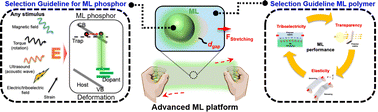
Mechanoluminescent solids are emerging as prime candidates for next-generation industrial and biomedical technologies, enabling effective light-based stress sensing without external power sources. However, directly transmitting stress into solid-state materials can be rather challenging, as it not only requires the application of high stress levels but also lowers the detection sensitivity, thereby limiting the practical utility of even high-performance mechanoluminescent materials. To use their performance to the limit, integrating polymer matrices that indirectly yet efficiently transmit stress to solids through interfacial triboelectric effects represents a groundbreaking strategy to impart morphological freedom, reduce the required mechanical stress, and maximize sensitivity. In this review, we comprehensively summarize the fundamental principles and mechanisms of ML composite systems, highlighting the synergistic roles of various polymers in improving mechanical compliance, luminescence efficiency, and device adaptability. Furthermore, we summarize various application cases enabled by these polymer-based ML composite systems, illustrating their potential in healthcare sensors, smart textiles, and biomedical platforms. Finally, by providing design guidelines for selecting and engineering suitable polymer matrices, this review establishes a blueprint for extending mechanoluminescent composites into broader application domains. These insights position polymer integration not merely as a supporting element but as a central strategy and roadmap for developing next-generation, high-efficiency, and adaptive ML platforms.
- This article is part of the themed collections: Mechanoluminescence and Journal of Materials Chemistry C Recent Review Articles
 Please wait while we load your content...


