


 PLATFORM UPDATE:


Optical and electrical characteristics of lead-free Cu-based halide perovskites in electrospun polystyrene nanofibers
 ab
Tobias
Haposan,
a
Dominik
Kowal,
c
Pramudita Anindita Prakasa
Tanaya,
d
Wulan
Chairunisa,
f
Sri
Hartati,
a
Lei
Zhang,
g
Joko
Suwardy,
h
Nandang
Mufti,
i
Akmal
Zulfi,
h
Lina Jaya
Diguna,
*j
Ismudiati Puri
Handayani,
de
Muhammad Danang
Birowosuto,
c
Witri Wahyu
Lestari
*b
and
Arramel
Arramel
*a
ab
Tobias
Haposan,
a
Dominik
Kowal,
c
Pramudita Anindita Prakasa
Tanaya,
d
Wulan
Chairunisa,
f
Sri
Hartati,
a
Lei
Zhang,
g
Joko
Suwardy,
h
Nandang
Mufti,
i
Akmal
Zulfi,
h
Lina Jaya
Diguna,
*j
Ismudiati Puri
Handayani,
de
Muhammad Danang
Birowosuto,
c
Witri Wahyu
Lestari
*b
and
Arramel
Arramel
*a
Abstract
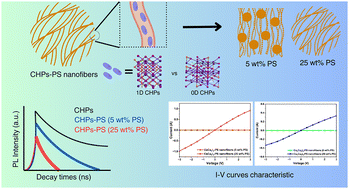
Cesium halide perovskites (CHPs) are highly regarded for their low toxicity and resistance to degradation, positioning them as promising candidates for optoelectronic devices. Incorporating CHPs into polymer matrices has further enhanced their stability, as the polymer's long molecular chains provide effective protection. Herein, we successfully incorporated CHPs into polystyrene (PS) via electrospinning using a post-encapsulation method. In this study, we examined the optical and electrical characteristics of CHPs–PS nanofibers with PS concentrations of 5 wt% and 25 wt%. The encapsulation of CHPs into the PS matrix enhances the absorption intensity and influences the emitted PL intensity, with higher PS concentrations resulting in reduced intensity due to the complete coverage of CHPs by the PS. In this study, CHPs–PS nanofibers also exhibit photoluminescence (PL) decay with a fast component (τ1) of up to 3 ns and an average decay time τavg of approximately 100 ns. To the best of our knowledge, CHPs–PS nanofibers exhibit a shorter average decay times (τavg) compared to pristine CHPs. The CHPs–PS nanofibers exhibit a tunnelling charge transport mechanism based on the I–V characteristics obtained. The non-linear I–V curves are attributed to the formation of a Schottky barrier, a potential barrier created at the metal–semiconductor interface when the two are connected. The findings of this study provide valuable insights into the development of CHP-incorporated polymer nanofibers, offering promising potential for applications in optoelectronic devices with exceptional optical and electrical characteristics.
 Please wait while we load your content...


