


 PLATFORM UPDATE:


Nd3+-doped 2D perovskite scintillators with ray-type-specific response via fragment-induced crystallization

Abstract
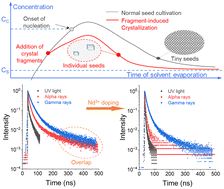
Strategic incorporation of heterogeneous elements through doping has emerged as a prominent methodology for optimizing the performance of halide perovskites. However, due to inherent self-purification mechanisms during crystal growth, achieving desired doping levels usually requires substantially elevated feeding ratios of dopants in precursors. High feeding ratios notably induce burst nucleation during seed generation, especially for 2D perovskites, which presents particular challenges in single-crystal fabrication. Herein, we developed a fragment-induced crystallization (FIC) methodology for synthesizing individualized neodymium (Nd) doped seeds of 2D perovskites. This approach utilizes easily produced undoped single crystals that are mechanically processed into crystalline fragments to create preferential nucleation sites. The FIC protocol enabled efficient production of monodisperse 1–3 mm-scale seeds and subsequent growth of centimeter-sized bulk single crystals. Successful Nd3+ substitution at Pb2+ sites with proportions varying from 0.04% to 3.43% was achieved. The doped perovskites showed a linear luminescence response up to 173 mGy s−1. Notably, they displayed differentially reduced decay lifetimes under excitation of ultraviolet light, α-rays, and γ-rays, signifying substantial potential for radiation discrimination. Nearly unchanged photoluminescence (PL) and X-ray luminescence (XRL) patterns indicated that Nd3+ worked not by forming new luminescent centers but by regulating luminescence of 2D perovskites. This study provides a methodology to effectively mitigate burst nucleation in heavily doped precursors and to shorten the preparation Nd3+-doped single crystals. Doping with Nd3+ is also an effective strategy for developing fast perovskite scintillators by tailoring their response time.
 Please wait while we load your content...


