


 PLATFORM UPDATE:


Alkyl-chain engineering of bifunctional amino acids in optoelectronically superior lead-free copper-based perovskite Cs3Cu2I5
 †a
Baisheng
Sa,
*a
†a
Baisheng
Sa,
*a
Abstract
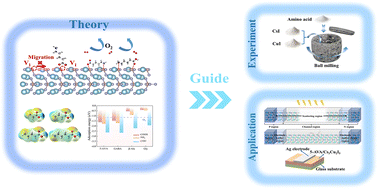
Lead-free Cs3Cu2I5 perovskite, featuring a low-dimensional structure and self-trapped exciton emission, presents significant promise for sustainable optoelectronics. Although mechanical ball milling has the advantage of being environmentally friendly and scalable, the optoelectronic performance of synthesized Cs3Cu2I5 is often constrained by lattice distortion, surface defects, and particle agglomeration induced during milling. To overcome these challenges, an alkyl-chain-engineered passivation strategy derived from amino acids was proposed through a combined theoretical calculation and experimental validation approach. Density functional theory reveals that the multifunctional amino acid and alkyl chain synergistically passivate both the coordination-deficient Cu+ ions and iodine vacancies prone to deep-level defects on the Cs3Cu2I5 surface. Interestingly, the extended alkyl chain significantly enhances the modification effect. Subsequent experiments and calculations further confirmed that longer alkyl chains effectively enhance photoluminescence, prolong carrier lifetime, suppress aggregation, and improve grain compactness by interacting with multiple functional groups through hydrogen-bond networks, steric hindrance, and internal electric fields. It is worth highlighting that 5-AVA-modified Cs3Cu2I5 achieved a remarkable PLQY of 75.6% (a 56.8% enhancement), prolonged carrier lifetime by 12.6%, and significantly enhanced UV-region photoresponse. Furthermore, the photodetector fabricated with this molecularly engineered green perovskite exhibits a nearly fourfold and 171% improvement in PDRC and switching ratio, respectively. This theory-guided, alkyl-chain-engineered molecularly synergistic multi-functional-group passivation strategy establishes a robust framework for green synthesis of optoelectronically superior, eco-friendly lead-free copper-based perovskites.
 Please wait while we load your content...


