


 PLATFORM UPDATE:


Preparation, color formation mechanisms and hydrophobic properties of anodic zirconia films
 *a
*a
Abstract
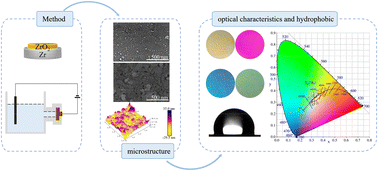
Zirconia films with structural color and hydrophobicity were successfully prepared on Zr substrates by anodization. Notably, precise control over the oxidation power supply and voltage (10–80 V) allows for manipulation of the resulting structural color and hydrophobicity. Increasing the oxidation voltage leads to a gradual increase in film thickness and a surface transition from a uniform dense to porous structure under the two power sources. Combined with UV-vis spectra, the formation mechanism of structural color is explained from the microscopic analysis of the thickness and surface structure. A critical thickness of 86 nm defines the transition in the coloration mechanism of ZrO2 films from the complementary color principle to film interference. Furthermore, excellent hydrophobicity with a water contact angle up to 113.9° (30% higher than the minimum contact angle of 87.6°) was achieved, stemming from surface roughness that was precisely tuned by controlling the anodization parameters. Furthermore, the excellent hydrophobicity of the films can be attributed to their roughness, which can be achieved by precisely adjusting the particle size and porosity. Offering adjustable coloration, angle-dependent effects, and desirable hydrophobic properties, zirconia films hold great promise for applications in anti-counterfeiting measures, outdoor decoration, and specialized waterproof equipment.
 Please wait while we load your content...


