


 PLATFORM UPDATE:


Matching drug and polymer for efficient delivery of anti-inflammatory drugs: PLGA, polyesteramides, and acetalated dextran
 ab
Philipp
Dahlke,
c
Alan
George,
d
Mingzhe
Chi,
d
Antje
Vollrath,
ab
Christine
Weber,
ab
Paul M.
Jordan,
bc
Stephanie
Schubert,
ab
Stephanie
Hoeppener,
ab
Ivo
Nischang,
abef
Marek
Sierka,
bd
Ulrich S.
Schubert
*abe
ab
Philipp
Dahlke,
c
Alan
George,
d
Mingzhe
Chi,
d
Antje
Vollrath,
ab
Christine
Weber,
ab
Paul M.
Jordan,
bc
Stephanie
Schubert,
ab
Stephanie
Hoeppener,
ab
Ivo
Nischang,
abef
Marek
Sierka,
bd
Ulrich S.
Schubert
*abe
Abstract
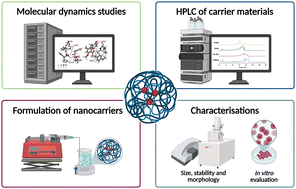
The hydrochalcone derivative MF-15 and the synthetically derived BRP-201 are potent anti-inflammatory active pharmaceutical ingredients (APIs) that suffer from poor bioavailability. This necessitates their incorporation into drug delivery systems. To address this limitation, we investigated four polymeric carrier materials. The poly(ester amide)s poly(3-benzylmorpholine-2,5-dione) (PPheG) and poly(3-isopropyl-morpholine-2,5-dione) (PValG), the benchmark poly(lactic-co-glycolic acid) (PLGA), and the polysaccharide acetalated dextran (Ac-Dex) were used to formulate nanoparticles via nanoprecipitation. The nanoparticles had sizes of around 110 to 190 nm with negative zeta potentials. Although atomistic molecular dynamics (MD) simulations predicted enhanced miscibility of PPheG and PValG with MF-15, the highest loading capacity was achieved with Ac-Dex (4.2 wt%). None of the MF-15-loaded particles elicited a biologic response (i.e., 15-lipoxygenase (LOX)-1 activation) in human M2 monocyte-derived macrophages (MDMs). The consistent failure across all MF-15 formulations, despite differences in polymer composition, drug loading, and enzymatic degradation profiles, suggests that encapsulation inherently interferes with MF-15's ability to activate 15-LOX-1, irrespective of the carrier system. In contrast, all BRP-201-loaded formulations demonstrated potent anti-inflammatory effects in human neutrophils. Overall, our findings demonstrate that polymer–drug miscibility and favorable physicochemical properties alone are insufficient to predict in vitro efficacy, highlighting the importance of kinetic and formulation-dependent factors in the successful delivery of anti-inflammatory agents.
 Please wait while we load your content...


