


 PLATFORM UPDATE:


Emissive and photothermal poly(N-isopropylacrylamide)-immobilized carbon-nanodots with thermoresponsive drug release properties
 *abcd
Grazia M. L.
Consoli,
bc
Giuseppe
Consiglio,
f
Mario
Scuderi,
g
Silvia
Scalese
g
and
Giuseppe
Forte
*a
*abcd
Grazia M. L.
Consoli,
bc
Giuseppe
Consiglio,
f
Mario
Scuderi,
g
Silvia
Scalese
g
and
Giuseppe
Forte
*a
Abstract
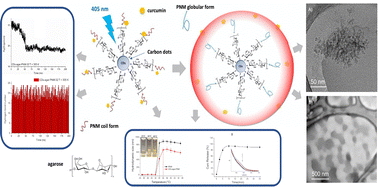
This study explores the design and synthesis of an innovative thermoresponsive nanocomposite for applications in drug delivery and controlled release. The nanocomposite core consists of carbon dots (CDs), covered by functionalized agarose units tethered to poly(N-isopropylacrylamide) (PNM), a thermoresponsive polymer with a lower critical solution temperature (LCST) of approximately 32 °C. Upon irradiation at 405 nm, localized heating within the CD core is efficiently transferred to the PNM shell through agarose linkages, resulting in modulation of the LCST toward physiologically relevant temperatures, optimal for biomedical applications. The structural integrity and composition of the CDs–agar–PNM nanocomposite were confirmed through ATR-FTIR spectroscopy, nuclear magnetic resonance (NMR) spectroscopy and scanning electron microscopy (SEM). Transmission electron microscopy (TEM) revealed the hierarchical structure of the material, showing ∼7 nm primary carbon domains aggregated into compact spherical nanostructures (∼200 nm) after PNM functionalization. Dynamic light scattering (DLS) analyses revealed that the coil-to-globule transition of PNM occurs at temperatures exceeding 34 °C. UV-Vis spectroscopy demonstrated effective loading of curcumin and its temperature-dependent release, with drug release triggered above the LCST threshold. Molecular dynamics (MD) simulations supported the experimental findings and provided additional mechanistic insight into the influence of the PNM chain length. The simulations revealed that longer polymer chains exhibit stronger adsorption onto agarose surfaces, mediated by increased hydrogen bonding, a higher number of intermolecular contacts, and more favorable interaction energies, ultimately resulting in an elevated LCST. The CDs–agar–PNM nanostructures composed of a C-sp2 inner core and an agarose–PNM outer shell showed good photothermal conversion properties (η = 38.8 ± 2.8%), blue-green photoluminescence yield and low cytotoxicity. Photophysical properties were demonstrated by the photogeneration of Au nanostructures upon 300 nm light exposure, according to the calculated semiconductor band-gap value of 2.45 eV. In summary, the synthesized nanocomposite exhibits enhanced thermal responsiveness, robust photothermal properties, and high structural stability, making it a promising platform for targeted cancer therapy and precision drug delivery applications.
 Please wait while we load your content...


