


 PLATFORM UPDATE:


Focused ultrasound propulsion of acoustically active nanoparticles into gelatin hydrogels
 *abc
and
Andrew P.
Goodwin
*ab
*abc
and
Andrew P.
Goodwin
*ab
Abstract
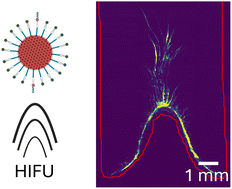
Dense biological tissues present formidable transport barriers that limit therapeutic penetration. Ultrasound-mediated propulsion can help to cross these barriers, but the presence of viscoelastic media can dampen ultrasonic cavitation and particle movement. The effect of gelatin (2–8% w/v) hydrogel mechanical properties (G′ ∼100–2100 Pa) on cavitation-mediated nanoparticle transport was tested using phospholipid-coated, hydrophobically modified mesoporous silica nanoparticles (DBPC HMSNs) and high-intensity focused ultrasound (HIFU). The minimum duty cycle required for effective penetration increased with hydrogel stiffness: 0.5% for 2% gelatin, 1.0% for 4% gelatin, and 3.6% for 8% gelatin. Soft hydrogels (2–4%) developed localized microchannels and release of gelatin from the gels only when treated with DBPC HMSNs under HIFU, but maintained their bulk mechanical properties. Stiff 8% gelatin exhibited organized honeycomb structures with 20–40% modulus reduction and amine release even in non-cavitating controls, indicating bulk weakening across all treatment groups. Non-cavitating control particles (unmodified MSNs) showed minimal penetration across all conditions, confirming cavitation as the primary driver of particle transport. SEM revealed treatment-dependent morphological changes across all HIFU-treated gels, including the formation of micropores and organized structures. These findings reveal that soft hydrogels (100–450 Pa) allow localized cavitation-mediated transport while preserving bulk integrity, whereas stiffer (>1000 Pa) hydrogels require higher acoustic intensities that inevitably cause bulk mechanical weakening. This stiffness-dependent response suggests that effective translation to biological barriers will require matching ultrasound parameters to target tissue mechanics.
 Please wait while we load your content...


