Issue 44, 2025

Carrier-free single-molecule hypoxia-activated nanoprodrug of SN38 with ultrahigh drug loading for pancreatic cancer treatment

Abstract

Pancreatic cancer remains one of the most lethal malignancies for human health. The anticancer drug SN38 has been proven effective against pancreatic cancer cells; however, its clinical application is limited by its poor aqueous solubility and restricted bioavailability in vivo. In this work, we developed a novel carrier-free single-molecule hypoxia-responsive nanoprodrug of SN38 for the treatment of pancreatic tumors. The nanoprodrug has an ultrahigh drug-loading content of ∼80 wt% and a nanoscale size of ∼50 nm. The drug molecules are masked by a hypoxia-sensitive aromatic azo group in the nanoprodrug, thereby shielding the therapeutic effects and toxicities of SN38 under normoxic conditions. Thus, the toxicity of the new regimen toward healthy cells and tissues is alleviated. In response to the upregulated level of azoreductase enzymes in the hypoxic tumor microenvironment, SN38 molecules are released in situ with their intact structures, exerting a powerful suppressive effect on tumor cells.
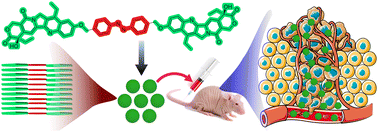
Graphical abstract: Carrier-free single-molecule hypoxia-activated nanoprodrug of SN38 with ultrahigh drug loading for pancreatic cancer treatment

Supplementary files

Article information

Article type
Paper
Submitted
15 Jun 2025
Accepted
09 Oct 2025
First published
09 Oct 2025
This article is Open Access
Creative Commons BY-NC license

J. Mater. Chem. B, 2025,13, 14416-14424

Carrier-free single-molecule hypoxia-activated nanoprodrug of SN38 with ultrahigh drug loading for pancreatic cancer treatment

A. Regmi, M. Elayyan, S. Nisar and B. Sui, J. Mater. Chem. B, 2025, 13, 14416 DOI: 10.1039/D5TB01434D

This article is licensed under a Creative Commons Attribution-NonCommercial 3.0 Unported Licence. You can use material from this article in other publications, without requesting further permission from the RSC, provided that the correct acknowledgement is given and it is not used for commercial purposes.

To request permission to reproduce material from this article in a commercial publication, please go to the Copyright Clearance Center request page.

If you are an author contributing to an RSC publication, you do not need to request permission provided correct acknowledgement is given.

If you are the author of this article, you do not need to request permission to reproduce figures and diagrams provided correct acknowledgement is given. If you want to reproduce the whole article in a third-party commercial publication (excluding your thesis/dissertation for which permission is not required) please go to the Copyright Clearance Center request page.

Read more about how to correctly acknowledge RSC content.

Social activity

Spotlight

Advertisements