


 PLATFORM UPDATE:


Decellularized-PRF and multiscale porosity in Si-doped MgP scaffolds: a strategy for enhanced bone regeneration
 †b
T. A.
Harinarayanan,
b
Satyabrata Nigamananda
Sahoo,
c
Mangal
Roy
*c
and
Samit Kumar
Nandi
*a
†b
T. A.
Harinarayanan,
b
Satyabrata Nigamananda
Sahoo,
c
Mangal
Roy
*c
and
Samit Kumar
Nandi
*a
Abstract
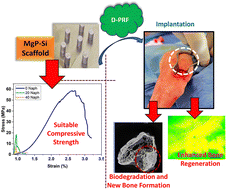
Magnesium phosphate (MgP)-based bioceramics have emerged as promising alternatives to bone substitutes; however, their rapid degradation and insufficient mechanical strength hinder their clinical applications. This study elucidated the fabrication, physicochemical properties, mechanical characteristics, and cytocompatibility of multiscale porous silicon-doped MgP scaffolds and decellularized platelet-rich fibrin (d-PRF) for application in critical-size bone defects. The scaffolds were fabricated through a cost-effective powder metallurgy route using naphthalene as a space holder (porosity: 6–51%). The findings revealed that the mechanical strength of the developed scaffolds ranged between 7 MPa and 56 MPa, similar to that of the human trabecular bone. A degradation study in a 7-day simulated body fluid (SBF) showed that the scaffolds with higher porosity (40 Naph) exhibited greater degradation (9–10% mass loss) and deposition of higher calcium (Ca) (0.24–0.26 wt%). The protein characterization of the synthesized d-PRF confirmed the presence of Aα polypeptide bands similar to human fibrinogen, and cell proliferation suggested that d-PRF has noncytotoxic and nontumorigenic effects on cells. When d-PRF was combined with the highly porous scaffolds (40 Naph), the cell proliferation significantly increased, possibly due to the sustainable release of d-PRF, leading to the prolonged stimulation of cell growth. In the in vivo evaluation, the scaffolds were bilaterally implanted into rabbit femoral condyle defects. After two months, radiographic, micro-CT, SEM-EDX, OTC labeling, and histological analyses demonstrated enhanced scaffold degradation, a radio-opacity resembling that of the host bone, increased osteogenesis, and improved collagen maturation in the 40 Naph + d-PRF scaffolds. Thus, the present study showed the synergistic effect of multiscale porosity (40 Naph) and d-PRF incorporation in Si-doped MgP scaffolds, making them promising candidates for bone tissue engineering applications.
 Please wait while we load your content...


