


High-energy ball-milling induced defect centers in hexagonal boron nitride (h-BN) for supercapacitor applications
 a
Mohammad Khairul
Islam,
d
Arpad Mihai
Rostas,
*b
Steven L.
Suib
*d
and
Emre
Erdem
*ace
a
Mohammad Khairul
Islam,
d
Arpad Mihai
Rostas,
*b
Steven L.
Suib
*d
and
Emre
Erdem
*ace
Abstract
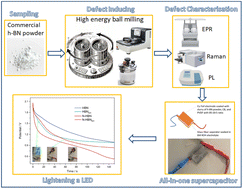
Hexagonal boron nitride (h-BN), a two-dimensional material known for its thermal stability and robust mechanical properties, is considered in fields ranging from nanoelectronics to energy storage. More recently, the importance of defect center engineering in h-BN has been highlighted, as the controlled introduction of defects can alter its electronic, optical, and mechanical properties, making it a promising candidate for advanced applications, such as energy storage in supercapacitor devices. Thus, in this study, two commercial h-BN samples were subjected to high-energy ball-milling to introduce defect centers, followed by comprehensive characterization using electron paramagnetic resonance, photoluminescence, and Raman spectroscopy. The results showed that nitrogen vacancy-rich h-BN exhibits considerable improvements in electrochemical properties after milling. This sample exhibited improved specific capacitance, reaching 615 F g−1 after ball milling, compared to 460 F g−1 for the pristine sample. At the same time, impressive energy and power density results with 85.4 Wh kg−1 and 10.25 kW kg−1 were achieved for the ball-milled sample. The best-working sample was used to power up a small LED light for 150 seconds, which requires 0.8 V to work. Regarding the stability of the supercapacitor devices, the capacitive retention after 1000 cycles exhibits excellent stability.
 Please wait while we load your content...


