


 PLATFORM UPDATE:

Highly efficient selective oxidation of benzyl alcohol to benzaldehyde on a PCM-engineered heat-storage catalyst via in situ thermal buffering and facilitated ROS yield
 a
Hongyi
Gao
*a
and
a
Hongyi
Gao
*a
and
Abstract
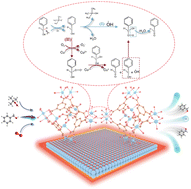
The development of advanced catalytic systems capable of effectively managing reaction heat while maintaining high selectivity remains a significant challenge in heterogeneous catalysis. In this work, we report the rational design and synthesis of a novel phase-change material (PCM)-engineered heat-storage catalyst, MEPCM@CuBTC, which integrates thermal-regulation and catalytic functions. The catalyst was constructed by encapsulating n-docosane within a Cu2O shell, followed by in situ growth of nanometer-sized CuBTC particles on the surface. This unique architecture enables dynamic absorption of reaction heat through the heat-storage capacity of the PCMs core, thereby preventing localized overheating and suppressing side reactions associated with thermal runaway. The synergistic integration of PCMs and CuBTC significantly enhances the generation of reactive oxygen species (ROS), particularly superoxide radicals (·O2−), which play a pivotal role in promoting the selective oxidation of benzyl alcohol. The prepared MEPCM@CuBTC-4h exhibits superior molecular oxygen activation and in situ thermal buffering ability, achieving a remarkable benzyl alcohol conversion of 75.8% with 100.0% selectivity toward benzaldehyde. Detailed mechanistic studies reveal that the PCM-promoted superoxide radical pathway dominates the oxidation process, outcompeting the hydroxyl radical (·OH)-mediated route. The work provides new ideas for catalyst design applied to exothermic reactions and a new paradigm for thermo-electronic synergistic catalytic systems.
 Please wait while we load your content...


