


 PLATFORM UPDATE:


Breaking barriers in nitrate electroreduction: robust Cu–Zn catalysts for selective ammonia production with ultra-high rate in neutral medium

Abstract
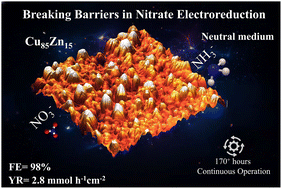
The electrocatalytic nitrate reduction reaction (NO3−RR) offers a sustainable route for ammonia synthesis under ambient conditions, presenting a more environmentally favorable alternative to the energy-intensive Haber–Bosch process. Achieving this transformation through emission-free fabrication methods positions NO3−RR as a highly attractive target for advanced research. However, realizing efficient NO3−RR remains challenging due to persistent issues with operational stability, selectivity, efficiency, and long-term performance, particularly in neutral media. In this study, we developed a robust, engineered Cu–Zn alloy catalyst system, with the Cu85Zn15 composition exhibiting the highest activity among all tested variants. In a neutral electrolyte, Cu85Zn15 achieved an exceptional faradaic efficiency of approximately 98% and an impressive ammonia yield rate of 2.8 mmol h−1 cm−2 at −0.8 V vs. RHE, surpassing most reported copper-based catalysts. The catalyst demonstrated remarkable durability, maintaining high selectivity and activity over 10 consecutive electrochemical cycles and sustaining continuous operation for over 170 hours, underscoring its potential for industrial application. Comprehensive surface characterization, including atomic force microscopy (AFM), electrochemical surface area (ECSA) analysis, underpotential deposition of lead (UPD-Pb), and electrochemical impedance spectroscopy (EIS), revealed that Zn incorporation enhanced surface roughness and created additional active sites. Notably, these enhancements were optimized at a Zn content of 15%; other compositions exhibited only moderate performance improvements. DFT calculations revealed that the Cu85Zn15 alloy optimally balances NO3− adsorption and intermediate stabilization, enabling low energy barriers for key steps in ammonia formation. Its unique Cu–Zn active sites enhance NO3− activation and suppress competing hydrogen evolution, explaining its superior NO3RR performance. Overall, this work highlights the high operational efficiency of Cu–Zn alloys under neutral conditions and demonstrates their promise for scalable industrial applications, owing to their low cost, long-term stability, and the natural abundance of constituent elements.
- This article is part of the themed collection: 2025 Journal of Materials Chemistry A Most Popular Articles
 Please wait while we load your content...


