


 PLATFORM UPDATE:

A theoretical study of 2D polymeric C24 networks as high-performance anchoring materials for lithium–sulfur batteries
 *a
*a
Abstract
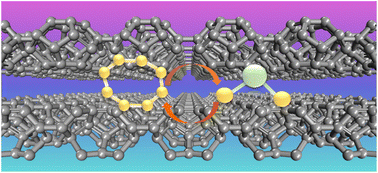
Lithium–sulfur batteries are seen as promising next-generation energy storage systems, offering numerous advantages; however, their large-scale commercialization encounters many challenges. This study employs first-principles calculations and ab initio molecular dynamics (AIMD) simulations to evaluate the potential of recently reported two-dimensional (2D) polymeric C24 networks as anchoring materials for lithium–sulfur (Li–S) batteries. Both quasi-hexagonal phase (qHP) and quasi-tetragonal phase (qTP) C24 monolayers and bilayers demonstrate kinetic and thermodynamic stability along with semiconductor characteristics. C24 bilayers show a significantly stronger affinity for S8 and lithium polysulfides (LiPSs), particularly long-chain species, effectively suppressing dissolution and the shuttle effect. This high affinity is supported by charge transfer assessments and large positive values of the integrated crystal orbital overlap population (COOP). A strong linear correlation between adsorption energies and COOP values establishes COOP as an effective bonding descriptor. Both C24 monolayers and bilayers demonstrate effective catalytic performance during the sulfur reduction reaction (SRR). Notably, C24 bilayers show superior catalytic activity for the decomposition of Li2S. The adsorption of S8 and LiPSs within C24 bilayers does not result in significant volume expansion. The C24 networks, in particular the bilayers, demonstrate exceptional anchoring and catalytic performance, offering promising potential for high-performance Li–S batteries.
 Please wait while we load your content...


