


 PLATFORM UPDATE:


Graphitic carbon cage structure encapsulating cobalt nanoparticles in nitrogen-doped biomass-derived carbon materials enables high-performance sodium–sulfur batteries
 *c
and
Yongcheng
Jin
*a
*c
and
Yongcheng
Jin
*a
Abstract
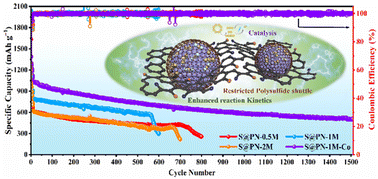
Room-temperature sodium–sulfur batteries have emerged as a promising candidate for large-scale energy storage applications due to their high theoretical energy density and cost-effectiveness. However, the polysulfide shuttle effect, slow reaction kinetics, and volume expansion of the sulfur cathode have seriously hindered their practical advancements. In this study, a novel biomass-derived carbon host (PN-1M-Co) was developed through a sustainable strategy integrating waste pine nut shells with cobalt (Co) compounds in the carbonization process. This material features a graphitic carbon cage structure encapsulating cobalt nanoparticles within nitrogen-doped carbon, with precisely regulated pore architecture. It is demonstrated that the PN-1M-Co accelerates the reaction kinetics of multi-electron reductions of sulfur through reducing activation energy, and it facilitates the direct one-step transformation of S8 to Na2S, bypassing the formation of intermediate polysulfides. Moreover, this carbon host mitigates the stress effects caused by electrode volume expansion during charge/discharge cycling. As a result, the S@PN-1M-Co electrode exhibits superior long-term cycling performances with a capacity of 509.9 mAh g−1 retained after 1500 cycles at 1C, and delivers a high capacity of 679.57 mAh g−1 at a current density of 5C. This work provides new insights into the design of novel biomass-carbon based carriers for low-cost and long-life room temperature Na–S batteries.
 Please wait while we load your content...


