


 PLATFORM UPDATE:


Stabilization of the nanoscale blend morphology in organic solar cells using solvent additives

Abstract
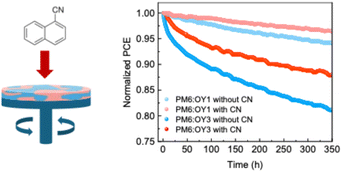
Solvent additives are commonly used to optimize the bulk-heterojunction blend morphology in organic solar cells; however, their impact on device stability under solar illumination remains unclear. Here we investigate the effect of applying 1-chloronaphthalene (1-CN) solvent additive on the stability of OSC devices based on PM6:OY1 and PM6:OY3 blends. We find that devices processed with 1-CN generally exhibit improved operational stability compared to those without 1-CN. Grazing-incidence wide-angle X-ray scattering results show that 1-CN additive significantly promotes out-of-plane π–π stacking of the acceptors in the blends. Transient absorption spectroscopy data reveal that prolonged solar illumination leads to substantial donor–acceptor mixing in the blends processed without 1-CN. Despite resulting in faster interfacial charge transfer, over-mixing also leads to reduced overall lifetime of free charges and thus decreased solar cell efficiency. In comparison, the addition of 1-CN suppresses the tendency for over-mixing between donors and acceptors under prolonged solar illumination and therefore reduces the rate of performance degradation.
 Please wait while we load your content...


