


 PLATFORM UPDATE:

Ultrasound-assisted directional freezing enables high-performance hydrogel evaporators with tunable microchannels for solar desalination
 a
Hang
Su,
a
a
Hang
Su,
a
Abstract
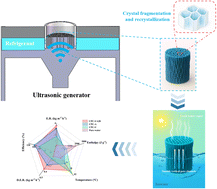
Improving interfacial evaporation rates and optimizing energy utilization efficiency remain critical challenges in solar-driven interfacial evaporation (SDIE) systems. Tuning the pore size and density of hydrogel structures has been widely recognized as one of the most effective strategies to enhance the performance of SDIE. Therefore, the development of a simple, general, and scalable strategy to precisely tailor the microporous structure of hydrogels is of great significance. Herein, we propose a novel approach that integrates directional freezing with ultrasound assistance to fabricate a series of poly(vinyl alcohol)/chitosan (PVA/CS)-based composite hydrogel evaporators for efficient solar steam generation. Experimental results demonstrate that acoustic cavitation notably disrupts the orderly growth of ice crystals, leading to the formation of denser and finer vertically aligned channels. Optimized CPC-UA28 hydrogels exhibited a reduced average pore diameter (from 25.4 μm to 15.8 μm) and a ∼40% increase in pore density, effectively enhancing capillary water transport, localized heating, and reducing heat loss by ∼26%. As a result, CPC-UA28 achieved an evaporation rate of 3.57 kg m−2 h−1 and 94% solar-to-vapor efficiency under one-sun illumination. It maintained stable performance in 25 wt% saline water, confirming strong salt resistance. Outdoor tests further validated its ability to continuously produce freshwater at 1.3 kg m−2 h−1, with good compatibility for agricultural irrigation. In summary, the ultrasound-assisted directional freezing method offers a universal and scalable strategy for constructing hydrogel-based evaporators with tunable microstructures, efficient photothermal conversion, and robust water purification performance.
 Please wait while we load your content...


